The Project Review : Philippine Real Estate News and Update

News and updates on real estate developments and projects; current event news updates; property listings; home and architecture; laws and regulations; education and seminars; people; ecology and environmental issues; geography and history; places of interest and events; travel and tourism; tips and how to; others matters allied to the the Philippine real estate industry. Trivia and rants on anything under the sun.
Showing posts with label Spain. Show all posts

Saturday, July 14, 2012

Economy : The Philippines on the Upswing

The Philippines is really an enigma! There was a time when the economies of its neighboring countries were all doing well and the Philippines was bungling with its own. It was even tagged as the basket case of Asia. But now that other countries' economies are slowing down or collapsing, its economy is surprisingly on the upswing. As a matter of fact, it is now the fastest growing economy in Asia.

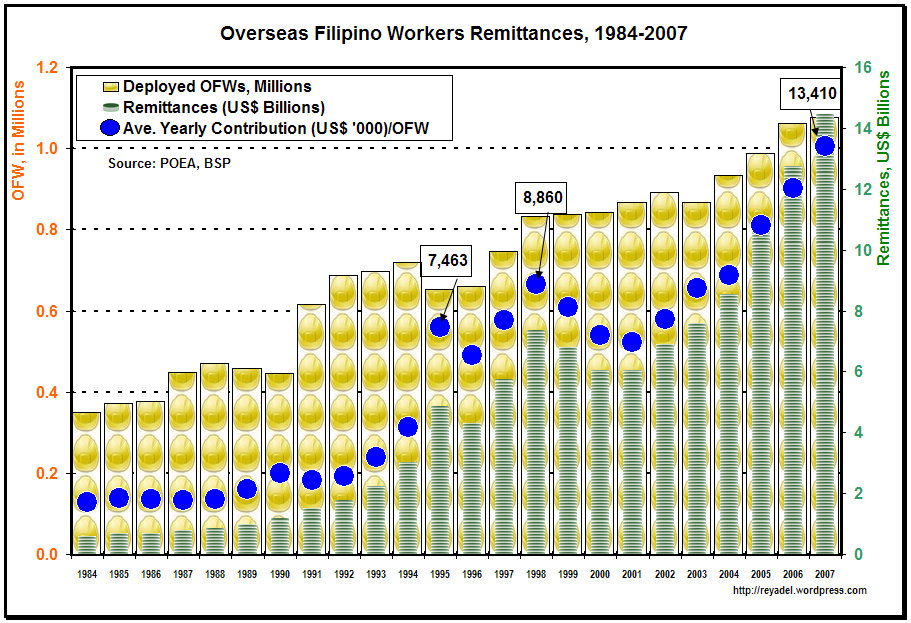
According to a CNN report, the growth is mainly due to two factors : the remittances of Overseas Filipino Workers and the booming call center industry. Normally, these factors are not what other countries would rely on to grow their economies, in fact it doesn't apply to most of them. Very few countries have big overseas workers population, and most do not have a call center industry. The only country which has a similar experience is India. India has a lot of overseas workers and also has a  booming call center industry. As a matter of fact,  it was the leading call center network in Asia until recently. Lately, the Philippines has overtaken India as the leading call center network in the region. But India is an industrialized country, unlike the Philippines which is basically an agricultural country.

Who would ever think that the facility of Filipinos to speak English as a second language would  someday be useful and eventually help in the economic recovery of their country. When Spain sold the Philippines to the Americans, the Philippines became a colony of the US for almost a century, and Filipinos were forced to learn the English language.

The Philippine Call Center Industry
And who would over think that Filipinos seeking employment and greener pastures abroad due to unemployment and lack of better job opportunities,  would someday help save their country's economy. Almost a tenth of the Filipino population are working abroad, and these millions of overseas Filipino workers are now remitting billions of dollars to the Philippines, thus helping its economy grow.

Click pictograph to enlarge
Overseas Filipino Workers Remittances (1987-2007)

Hopefully, the Philippines has reach its turning point.


News Source :
http://edition.cnn.com/2012/07/12/world/asia/philippines-surprise-surge/index.html?eref=edition&utm_source=dlvr.it&utm_medium=twitter&utm_campaign=cnni

Picture  source :
filipinocallcenter.com

Thursday, June 28, 2012

History : An Old Spanish Map Showing Panatag Shoal as Part of the Philippine Islands Territory

Here's an old Spanish map that substantiates our  claim that the Scarborough Shoal has always been a part of the Philippine territory since the Spanish colonial period. Philippines being a colony then, Spain  would not have included the shoal in this map if it was not a part of its territory.

The map was made by Jesuit priest Pedro Murillo Velarde in 1744. It shows the Philippine Islands, including a shoal named Panacot, known today as Panatag or Scarborough. 

Click map to enlarge
An old Spanish map of the Philippine Islands showing Panatag Shoal as part of its  territory.

Related News and Picture Source:
http://www.philstar.com/Article.aspx?articleId=821746&publicationSubCategoryId=63
Related Link :
http://theprojectreview.blogspot.com/2011/11/interesting-places-spratly-islands.html

Monday, June 25, 2012

News Update : The Philippines Lends $1 Billion to IMF

When I heard this news, I thought it was a big joke. But when I finally read the news article, I realized that it is true indeed. For so many years our country has been a borrower and recipient of millions of dollars in loans from the different  international financing institutions and some benevolent rich countries, and now the table has been turned and we are lending money to IMF (International Monetary Fund) to save Europe from their financial and economic problems. (As BSP Governor Tetangco said in Mr. Boo Chanco's article, Demand and Supply, Philstar : it's payback time).

I never imagined our country has that much money in its dollar reserves to be able do this. (I think we should thank all the Overseas Filipino Workers and Filipino-Americans who have contributed much to these dollar reserves). By the way, have we paid all our foreign debts already? I guess every Filipino like me who doesn't know much about economics, has the same questions in their mind.

But the good thing is, this is really one very good news to hear.


Related News Link :
http://www.philstar.com/Article.aspx?articleId=820609&publicationSubCategoryId=66
About IMF :
http://www.imf.org/external/about.htm
http://www.interaksyon.com/article/36085/manuel-buencamino--miriams-primer-for-illiterate-politicians-and-critics

Sunday, June 24, 2012

Architecture : The Filipino Architecture

Is there really a distinctly "Filipino Architecture"?

Considered as typical and common Filipino architecture and house design are the "bahay na bato" and the "bahay kubo". Despite their being made of different materials, their designs are quite similar : open ground floor, big windows, slatted floors or walls, and upper floor used as living area.

Regional architectures like those seen in Batanes, Mountain Province/Cordillera, Muslim Mindanao and other places are  uncommon but still part of  the diverse Philippine architectures.

The general design of typical Filipino houses is basically influenced by the hot and humid weather of the country. The open ground floors, slatted floors or walls and big windows are natural cooling systems which let air circulate in these houses.

Regional designs may also be influenced by other factors such as the regular typhoon season, earthquake,  elevation and temperature or location e.g. coastal, on-water settlements .

But despite these typical  and regional Philippine architectures  and designs  mentioned, there is not yet one singular design or look that may represent what one may call a distinctly "Filipino Architecture".

Maybe the Philippines  is still a young country, and a young culture at that,  and still is evolving and creating its uniquely Filipino look. Proof is the non existence of any pre-hispanic monuments or structures. Surviving old edifices and monuments are mostly Hispanic ones. Unlike its neighbors: Indonesia and Thailand, who are both very old cultures and have their own distinct architectures.

Because the Philippines was colonized by Spain for a very long time, its architectures and designs will always have  Hispanic influence, much like Mexico. But despite the Hispanic influence on Mexico, it has a distinctly Mexican architecture that is fused with its native Indian/Aztec designs. But then again Mexico is an old and ancient culture.

Defining that one singular  and unique Filipino design or look is what is needed to have a distinctly Filipino architecture.  It might be a fusion or combination of existing regional architectures, Hispanic-influenced or a new revolutionary design. But it must be distinctly Filipino, representing its people and culture : the Pinoy Architecture.

Bahay na Bato
Bahay Kubo
Batanes Stone Houses
Igorot House
The Coconut Palace in Manila


Related Link : 
Picture Sources :
Batanes Stone House:
www.philstar.ecom
Coconut Palace :
www.wikipedia.org
Bahay Kubo :
http://www.pinoyflick.com/
Igorot House :
http://ayaysalidummay-photo.blogspot.com/